


This list contains spoilers!
Summary
- Not every story needs a happy ending; some leave a lingering ache.
- Spec Ops: The Line offers a morally harrowing narrative in a warzone.
- Shadow of the Colossus reveals the consequences of selfish quests for love.
Not every story needs a happy ending. Sometimes, what lingers after the credits roll isn’t triumph or closure, but a deep, nagging ache, the kind that sticks in the ribs for days. These are the stories where the finale doesn’t tie things up with a bow but instead leaves things frayed, unresolved, or downright tragic.
And yet, it’s exactly what the story needed. The kind of endings that feel wrong in all the right ways.
6 Spec Ops: The Line
War Is Hell, And So Is Realizing You're The Villain

Spec Ops: The Line

- Released
- June 26, 2012

WHERE TO PLAY


There’s no grand victory waiting at the end of Spec Ops: The Line. No medal ceremony, no righteous justification, just the slow unraveling of a soldier’s psyche in a warzone that stopped making sense long ago. What starts as a standard military shooter quickly turns into one of the most psychologically harrowing narratives in modern gaming — a deliberate descent into moral rot.
Captain Martin Walker arrives in Dubai to rescue survivors after a devastating sandstorm, but every decision made after that spirals into chaos. Players expecting a clear good-versus-evil arc get something far messier — choices that feel wrong no matter what, a body count that grows increasingly senseless, and the creeping realization that none of it was heroic.
By the time the ending hits, there’s no redemption left to salvage. Whether Walker survives or not, the weight of his actions can’t be erased. The infamous white phosphorus scene is like a mirror held up to the player, forcing them to confront what they participated in. It’s an ending that feels hollow, broken, and uncomfortable. But in a story about the horrors of war and the fragility of morality, it fits like a bullet casing hitting the floor.
5 Inside
The Final Stretch Is A Crawl, But So Was The Whole Journey

Inside
- Released
- June 29, 2016



WHERE TO PLAY







Nothing about Inside tries to explain itself — not the silent boy in the red shirt, not the eerie, dystopian world he moves through, and certainly not the ending that’s been dissected more times than any puzzle in the game itself. But that’s part of the unease that makes it so haunting.
From the very start, everything feels off. People stand motionless under some unseen control, grotesque experiments twitch behind glass panels, and security drones stalk the shadows. And then there’s that ending, where the protagonist becomes a writhing mass of flesh, limbs, and screams known as the Huddle, breaking out of the research facility only to slump lifelessly in the sunlight.
It’s deliberately unsatisfying; there’s no revelation about who the boy was or what the facility was doing. No sense of victory. Just the implication that whatever was driving him, it may not have been free will at all. Some believe he was being controlled the whole time. Others think he was the controller. But the ambiguity is the point of the game. It’s the final, oppressive note in a story where control was always an illusion.
4 Telltale’s The Walking Dead Season 1
Sometimes Goodbye Is The Hardest Choice, Even When It’s The Only One

The Walking Dead
- Released
- April 24, 2012


WHERE TO PLAY

- ESRB
- Mature 17+ // Blood and Gore, Drug Reference, Intense Violence, Sexual Themes, Strong Language
- Genre(s)
- Graphic Adventure, Horror

Few endings hit as hard as Lee Everett’s final moments in Telltale’s The Walking Dead: Season 1. After hours of protecting Clementine from walkers, strangers, and every form of human cruelty, Lee finds himself bitten — a slow death sentence in a world that doesn’t have time for grief.
The last scenes are devastating not because of gore or spectacle, but because of what’s asked of Clementine. She has to say goodbye to the only person who kept her alive and taught her how to survive, and she has to do it by either leaving him to turn or pulling the trigger herself. It’s not a decision a child should ever face, but this world doesn’t care about childhood.
And that’s what makes the ending feel so right. It’s unfair, abrupt, and deeply painful, but it mirrors everything Lee fought against — that sense of lost innocence, the price of survival, and the inevitability of loss. The series could’ve easily given him a miraculous escape, but it wouldn’t have meant as much. The ending hurt because it was earned.
3 Shadow of the Colossus
When The Giants Fall, So Do The Innocent

Shadow of the Colossus
- Released
- October 18, 2005

WHERE TO PLAY

- ESRB
- T For Teen // Blood, Fantasy Violence
- Developer(s)
- Team Ico
- Platform(s)
- PlayStation 2

What starts as a quiet, melancholic tale of love and sacrifice turns into a slow realization that nothing about this quest is noble. Shadow of the Colossus doesn’t have traditional villains — just sixteen towering colossi who never attack first, many of whom are simply minding their own business until Wander climbs onto their backs with a sword in hand.
Players spend hours slaying these massive creatures, each more awe-inspiring than the last, only to discover they are ancient guardians keeping a malevolent force sealed away. And every time one falls, Wander gets a little more corrupted — physically and spiritually — until he’s unrecognizable.
The ending lands like a stone on the chest. Wander’s body is twisted beyond saving, the woman he tried to bring back awakens but never gets to truly see him, and the price of his obsession echoes long after the credits. There’s no victory in what he did. Just consequences. The final scene, with a child born from the ashes of a cursed man, is the only glimmer of hope — and even that feels like a faint whisper in a story drenched in regret.
2 The Last of Us Part 2
No One Really Wins When Revenge Is The Goal

The Last of Us Part 2
- Released
- June 19, 2020
WHERE TO PLAY
- ESRB
- M for Mature: Blood and Gore, Intense Violence, Nudity, Sexual Content, Strong Language, Use of Drugs
- Developer(s)
- Naughty Dog
- Platform(s)
- PlayStation 4, PlayStation 5
Few stories have sparked as much debate as The Last of Us Part II, and it’s not hard to see why. This is a game that spends 30 hours making players feel every inch of pain, resentment, and grief that comes from a cycle of revenge that refuses to break.
Ellie’s journey isn’t about justice. It’s about anger that festers until it consumes everything. The story doesn’t shy away from making players sit with that discomfort — forcing them to walk in Abby’s shoes, feel the humanity of the supposed villain, and then come full circle to question who deserved what.
The final moments don’t offer catharsis. Ellie loses her loved ones, her home, and even the ability to play Joel’s guitar — the last link to the person she was avenging. And when she finally lets Abby go, it doesn’t feel triumphant. It feels like defeat. But that’s exactly what makes it honest. In a story about how pain poisons everything it touches, a clean, happy ending would’ve felt like a lie.
1 Red Dead Redemption
A Man Can’t Outrun The Past, No Matter How Noble The Present

Red Dead Redemption
- Released
- May 18, 2010
WHERE TO PLAY
- ESRB
- M For Mature 17+ Due To Blood, Intense Violence, Nudity, Strong Language, Strong Sexual Content, Use of Drugs
- Developer(s)
- Rockstar San Diego
- Platform(s)
- Nintendo Switch, PC, PlayStation 3, PlayStation 4, Xbox 360, PlayStation 5, Nintendo Switch 2, Xbox Series X, Xbox Series S, Android, iOS
- Genre(s)
- Open-World, Adventure
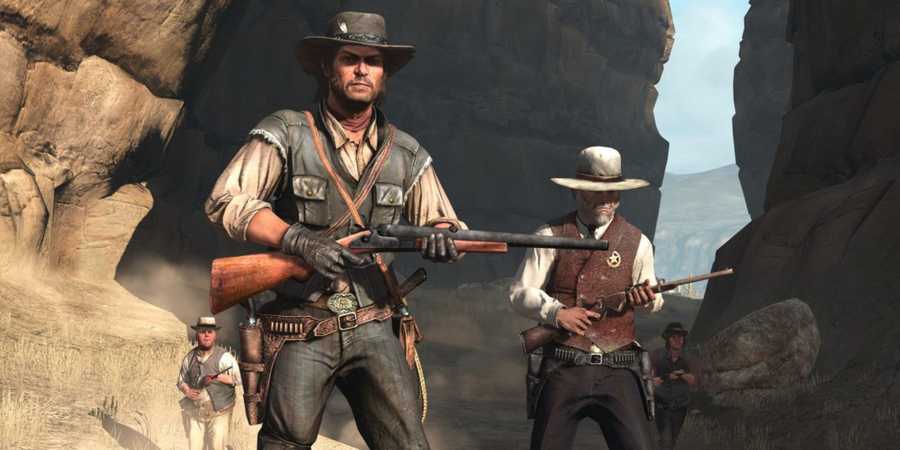
The final moments of Red Dead Redemption are the kind that never quite leaves. John Marston spends the whole story trying to leave his outlaw past behind, building fences, tending his ranch, and trying to give his family the peace he never had. But the world doesn’t forgive as easily as he does.
After everything he does for the government — tracking down his old gang, enduring betrayal after betrayal — the ending hits like a gut punch. A firing squad waits for him in his own barn. He knows it but still opens the door. There’s no final shootout where he emerges victorious. Just a last stand, a hail of bullets, and the realization that redemption is rarely ever rewarded.
Even worse, Jack’s epilogue isn’t about healing. It’s about vengeance. He grows up and kills the man responsible, mirroring the same cycle John tried to escape. It’s a deliberately bleak ending that says more with its hopelessness than any happy ending could have. Marston dies a hero, but it doesn’t change the world. And that’s what makes it hurt.

11 Best Happy Endings In Horror Games
The horror genre isn't exactly known for being wholesome, but these games, both horror and adventure, have surprisingly happy endings.