


One of the most celebrated JRPG series of all time, the Final Fantasy franchise from Square Enix has a staggering number of different ways for players to level up their characters and improve their efficacy in battle. One of the defining features of an RPG is the ability for players to level up, sometimes easily and sometimes with extreme grinding.
This is a franchise that's never been afraid to experiment, something which is easy to see from its expansive list of games with some very unusual mechanics. Here are ten of the most time-consuming level up systems from the Final Fantasy franchise.
.jpg?q=50&fit=crop&w=140&h=98&dpr=1.5)
6 Games That Punish You For Grinding
Grinding is an aspect most players expect in RPGs, but these titles punish the player for trying to game the system.
10 Final Fantasy 5
Non-Transferable Skills

Final Fantasy 5
- Released
- December 6, 1992
- Developer(s)
- Square Enix
- Genre(s)
- JRPG

Final Fantasy 5 had traditional leveling, but it was paired with a job system. Jobs and character levels are separate. So, while a character had their own level, the job they were assigned had a different level. So any players looking to really maximize their gains have to take a bit of extra time to do it. While the benefit of this was having characters that were powerful in multiple jobs, it took a long time to accomplish.
9 Final Fantasy Tactics
Prior Experience Required

Final Fantasy Tactics
- Released
- June 20, 1997
- Developer(s)
- Square
- Platform(s)
- PlayStation (Original)
- Genre(s)
- Tactical, RPG
Final Fantasy Tactics separates job and character levels, which immediately makes it take a bit longer to level up. But it doesn't stop there, because some jobs require levels and experience in other jobs to unlock. On top of that, the amount of experience required to level up a job increases with each level. As a result, leveling a job was a long and tedious process.
8 Final Fantasy 13
The Crystal Method

Final Fantasy 13
Tying into the story of the game, Final Fantasy 13 characters gain Crystogen Points which they can spend on abilities and stat increases on their personal Crystarium. But there are many different roles, and although characters are initially locked to certain roles called Paradigms, later on they can change them up.
Pair this with the item and weapon level up system and it can take a bit of time for beginners to get to grips with everything, let alone max it all out.
7 Final Fantasy 13-2
Monsters With Jobs

Final Fantasy 13-2
- Released
- January 31, 2012
- Developer(s)
- Square Enix
- Genre(s)
- JRPG
Final Fantasy 13-2, the sequel to Final Fantasy 13, built on its predecessor's leveling system and made it a bit more complex. In FF13-2, paradigm roles each go up to level 99, and each role has its own level. This can make leveling a bit more time-consuming even if it does give a few more options for building characters. Adding to the complexity is that monsters, allies used by main protagonists Serah and Noel, get their own roles to fill with a Crystarium with progression, too.
6 Final Fantasy 10-2
Dress Up Time

Final Fantasy X-2
Final Fantasy 10-2, the surprise sequel to the beloved FF10, has a traditional level-up system that's quite straightforward. It also has a unique job system called Dresspheres, where the three player characters change outfits to access new abilities.
Fun, but each job has to be leveled up separately, gaining levels when players successfully gain AP and apply it to learning abilities. If they've managed to find and unlock them, that is. Some of the Dressspheres were easier to get than others, which added to the time-consuming nature of leveling in Final Fantasy 10-2.

Final Fantasy 10-2: How To Unlock All Of The Dresspheres
Final Fantasy 10-2 was an interesting adventure in terms of gameplay mechanics thanks to Dresspheres. Here's a look at how to unlock them all.
5 Final Fantasy 12
Do You Have A License For That?

Final Fantasy 12
Final Fantasy 12 gives players a traditional level up system requiring a whopping 13million+ experience to reach level 99, but it also comes with a License Board system where players need to spend LP on buying new abilities such as being able to wield different types of weapons or wear different armor.
On top of that, players also needed to use LP to be able to use magic spells as part of a separate purchase. Obviously, with a system like this, it took a very long time to progress characters in terms of their power.
4 Final Fantasy 11
Work, But It's Fun

Final Fantasy XI
Final Fantasy 11 was a departure for the franchise, being its first MMO. Launching without traditional character levels, FF11 instead has a job system. Players can swap roles at any time by returning to their Mog House, but each role has a separate level progression, making this a nightmare - or a dream - for completionists.
3 Final Fantasy 10
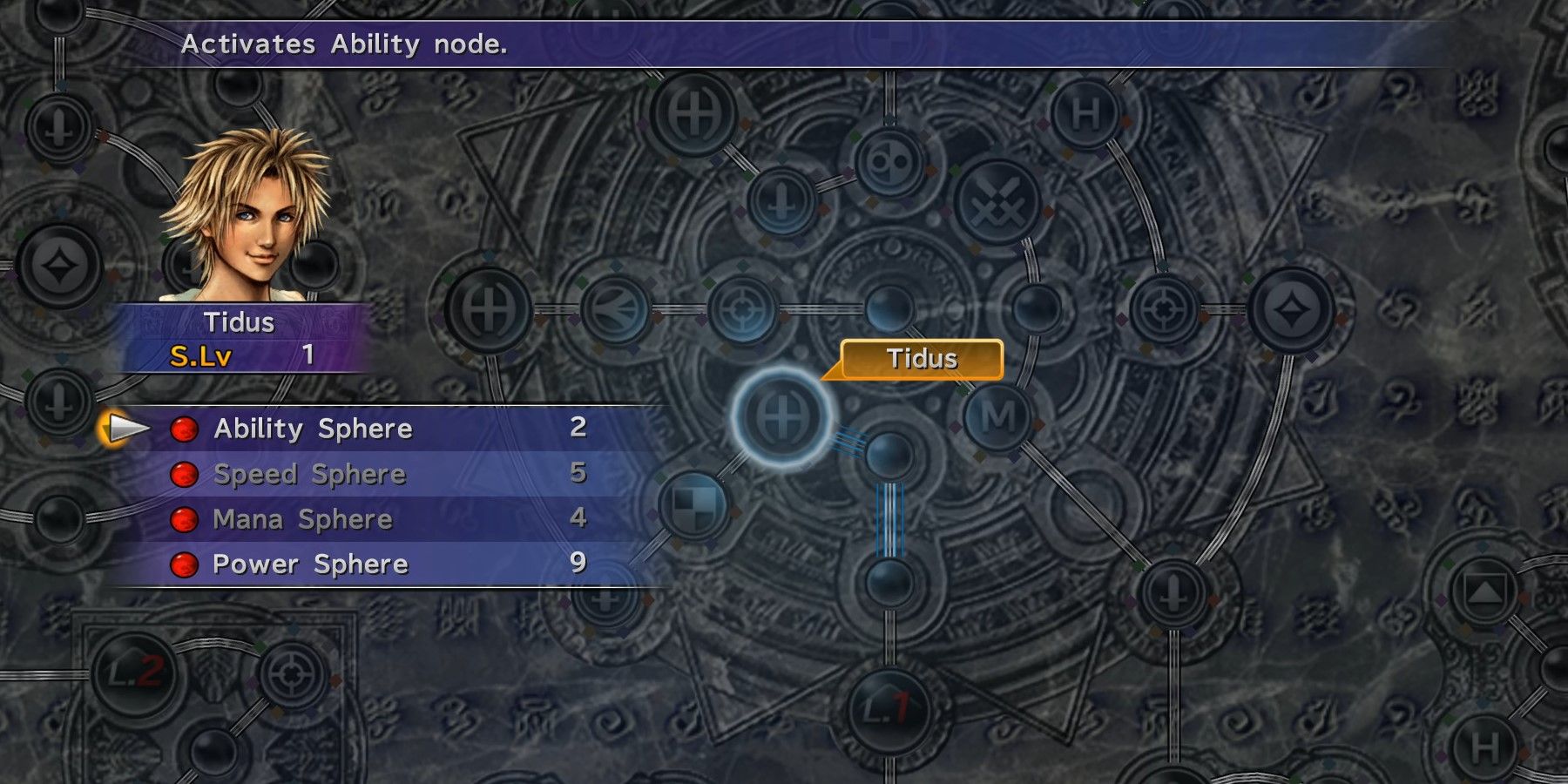 The Sphere Grid
Final Fantasy 10
- Released
- December 17, 2001
- Developer(s)
- Square Enix
- Platform(s)
- PS2
- Genre(s)
- JRPG
Final Fantasy 10, the tenth main-line game in the franchise, comes with an interesting and unique method for players to level up their characters. Eschewing the more traditional level system where characters gain levels, FF10 introduced the Sphere Grid.

8 JRPGs That Do Not Have Traditional Level-Up Systems
The endless grind for levels is a classic JRPG feature, except when it comes to the following video games with unique systems.
The Sphere Grid was a massive network of interconnected nodes which players could travel using their "Sphere Levels" gained after battles. Each node of the Sphere Grid was of a different type: empty, a HP raising node, a node which granted a specific ability, etc. This gave players an almost unprecedented flexibility in how to build their characters, but each node also needed specific items to unlock it. And if players wanted to fill up the empty nodes, they needed yet more items whose availability was best through a mini-game which itself required a lot of grinding.
2 Final Fantasy 2
Use or Lose It

Final Fantasy II
- Released
- December 17, 1988
- Developer(s)
- Square
- Platform(s)
- Nintendo Entertainment System, Android, iOS, Nintendo Game Boy Advance, PC, PS1, PS4, PSP, WonderSwan
- Genre(s)
- JRPG
Smash-hit Bethesda game Skyrim isn't the first thing that comes to mind when thinking about the Final Fantasy franchise, but many fans enjoyed its level-up system which required using specific abilities and so on to level up. But Final Fantasy 2 did it first... And much more painfully.
For a character to level up its HP, said character needed to finish a battle with low HP. To level up its Evasion, it needed to evade attacks successfully in battle. Despite being a flexible system offering many ways to build a character, it was quite a time-consuming level-up system, especially for people who wanted to min-max their characters thanks to the inherent RNG-based nature of some of the requirements.
1 Final Fantasy 14
Massively Multiplayer Online Work Experience

Final Fantasy 14 (2010)
- Released
- August 27, 2013
- Developer(s)
- Square Enix
- Platform(s)
- PC, PS3, PS4, PS5, Xbox Series X, Xbox Series S
- Genre(s)
- MMORPG
Final Fantasy 14 is the franchise's second - and very successful, after a comeback - entry to the MMO landscape. Once again featuring a flexible job system, FF14 jobs are all leveled up separately. But not only does FF14 have the job system, it has item levels and special weapons for certain classes as well. Being an MMO means there's an awful lot of different ways to measure progression and chase power, making leveling in FF14 a very time-consuming endeavor if players want it to be.
And as an on-going live-service game it's likely that there will be increases to level caps, new jobs, and entirely new systems to level up in the future too. While leveling the first job you choose is pretty easy because of the generous amount of EXP the Main Story Quest (MSQ for short) provides, the rest will take significantly longer since the only meaningful source of EXP beyond MSQ is the daily roulettes.

Final Fantasy 7: Ranking Yuffie's Costume Changes Over The Years
Final Fantasy 7's Yuffie has had several costume changes over the years. Here's every costume ranked from worst to best.