


When a franchise has been around as long as Final Fantasy has, it can either rest on its laurels or choose to constantly reinvent itself. The reason Final Fantasy has remained so popular is that it has never been afraid of the latter. For more than two decades, the series featured turn-based battles, but each game's system was different.
Eventually, the franchise ditched turn-based battles altogether, but a quick look at the best Final Fantasy games shows that many fans preferred the old ways. Turn-based battles were slower-paced, but allowed for high degrees of strategy. The best turn-based battle system is a matter of personal taste, so instead of ranking them, here's what made each system special.

9 Final Fantasy Games With The Best Real-Time Combat, Ranked
The Final Fantasy series has experimented with several combat systems, including real-time.
10 Final Fantasy 3
Introduced Jobs And Summons

- Released
- April 27, 1990
- Developer(s)
- Square Enix, Tose
- Platform(s)
- Nintendo DS, PlayStation 4, Nintendo Switch, iOS, Microsoft Windows, Nintendo Wii U
- Genre(s)
- Adventure

FF3 isn't the best-remembered Final Fantasy game, but it did play an important role in the franchise's evolution. Players select actions for their party members at the start of each round, and those actions are carried out in a sequence decided by each character's agility stat.

7 Best Rivalries In Final Fantasy, Ranked
The Final Fantasy series has had some pretty heated rivalries over the years, some of which have gone down as iconic within the history of gaming.
However, FF3 added a couple of wrinkles. It introduced a job system including classics like Warrior, Black Mage, and White Mage. In total, the original had 22 jobs, each with unique abilities and stats which players were free to swap between outside of combat. Secondly, FF3 introduced the franchise's iconic summons to turn-based battles. These weren't as hard to unlock as in other games, but were an exciting new addition.
9 Final Fantasy 4
The Active Time Battle Debuts

If one were to ask long-time Final Fantasy fans what they miss most about the older games in the franchise, many would say the ATB (Active Time Battle) system, which made its glorious debut in Final Fantasy 4. Unlike in earlier games, each character has an ATB gauge that fills over time with its speed based on the character's speed stat. When the gauge is full, that character can take action. ATB added a real-time element that made battles feel more fast-paced and dynamic.
In other areas, the game went back to the basics, scrapping the job system in favor of characters having fixed classes. It upped the party size to five, whereas most FF games usually have three characters, four max. It also made some changes to the summon system. In FF4, the summons could be acquired via items dropped by enemies. It was a cool idea, but unfortunately, most summons were incredibly weak.
8 Final Fantasy 5
The Best Of 3 & 4

- Released
- December 6, 1992
- Developer(s)
- Square Enix
- Genre(s)
- JRPG
With Final Fantasy 5, the developers focused less on innovation and more on combining the best elements of games 3 and 4. It stuck with the ATB system, but knocked the party size back down to four. For the most part, that was a welcome change, as five characters in an ATB system can start to feel unwieldy.
It also brought back and expanded upon FF3's job system, adding a system where characters gain job levels to unlock new abilities. Furthermore, it included ability inheritance, a system where characters could equip abilities from other jobs. This allowed for more customization and strategy in battle.
7 Final Fantasy 10-2
Fashionable Additions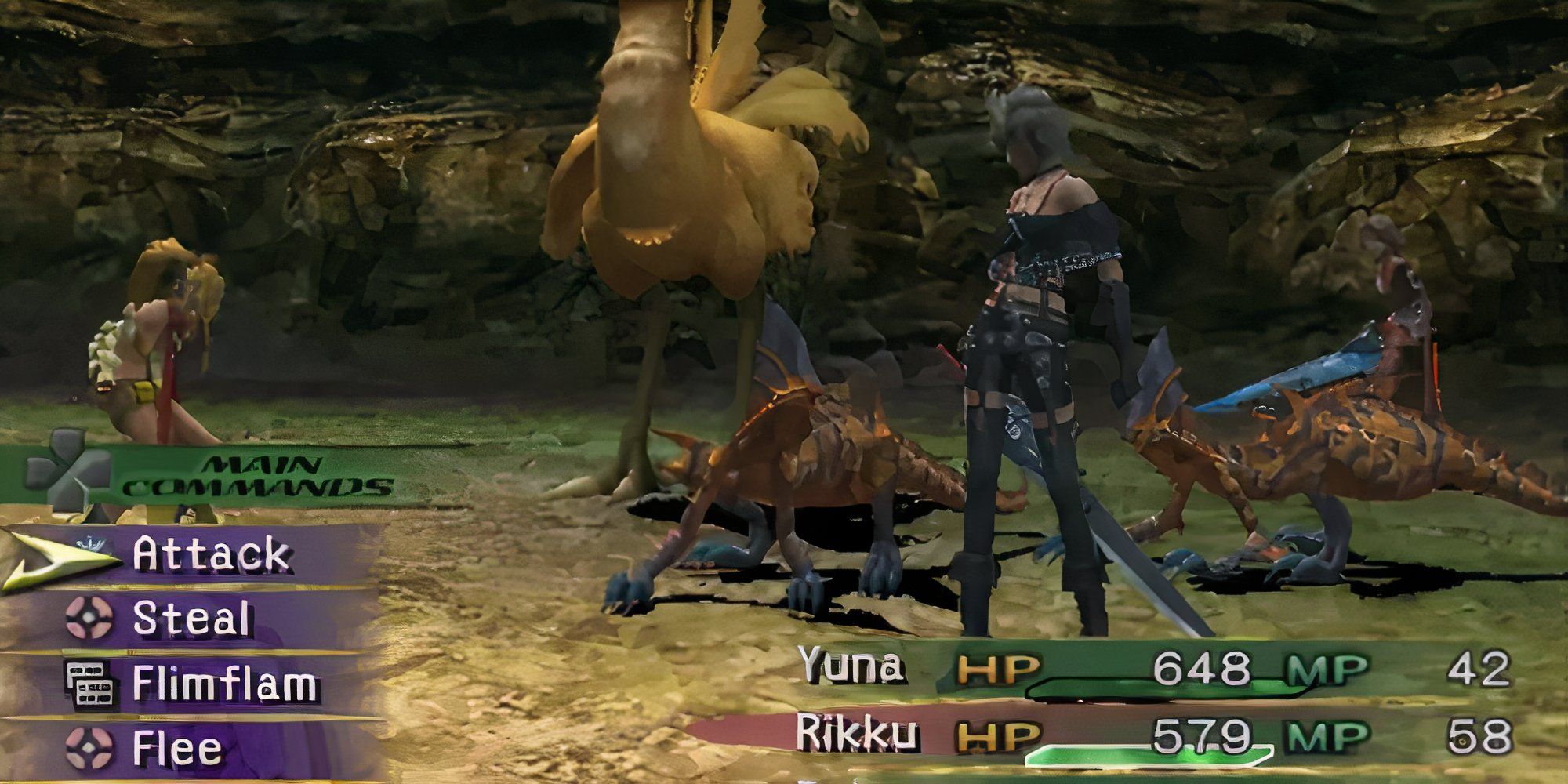
Nobody will claim that Final Fantasy 10-2 is the best game in the franchise, but it is one of the most innovative. By the early 2000s, some gamers were beginning to tire of more traditional turn-based battle systems, so Square decided to get weird with 10-2.
In FF10-2, the three playable characters can change their class during battle via the Dressphere system and the Garment Grid. Each Dressphere comes with different abilities and roles which can be swapped during battle. The game was also the first to include Chain Attacks, which offered a damage boost if characters timed their attacks to land simultaneously. Finally, the game stuck the player with the same three characters for the entire game. Not all these additions were well-received, but FF10-2 is a classic example of how Final Fantasy is never afraid to mix things up.
6 Final Fantasy 13
The End Of An Era

Final Fantasy 13 is one of the most controversial games in the series. While some fans loved it, many were less impressed. That's largely thanks to the game's linear structure, but the changes it made to the ATB system also upset some fans. FF13 introduced the paradigm system, which worked a bit like Dresspheres. Characters could switch between different roles called "Paradigms," allowing for real-time role switching to adapt to different combat situations.
The game also changed the ATB system. The ATB gauge was now segmented, with different actions requiring different numbers of segments to use. FF13 added a stagger mechanic, which dealt massive damage once an enemy was "staggered." It also added a chain bonus where attacks filled up a chain gauge to deal increased damage. Finally, it mixed up the summon system by having them become transformers. Many felt the system was a mess, and a final effort to make the aging tunr-based system feel relevant.
5 Final Fantasy 6
A Refined System

Final Fantasy 6 is one of the franchise's most popular entries. Everything about it, from its epic story to gorgeous pixel art to its brilliant battle system, is beloved by old-school fans. It refined everything that had made earlier games so popular, and that's true for turn-based battles as well.
For FF6, the developers didn't add many flashy new features. They ditched the jobs system once again and focused on crafting a cast of playable characters who all felt unique and came with their own special abilities. While some of these were mandatory, a good few of them were unlockable secret characters. The game kept the ATB system and added a new attack type called desperation attacks, a precursor to later games' limit breaks.
4 Final Fantasy 7
Encouraged Player Freedom

- Released
- January 31, 1997
- Developer(s)
- Square Enix
- Platform(s)
- PlayStation (Original), PC, iOS, Android, Nintendo Switch, Xbox One, PS4
- Genre(s)
- RPG
After FF6 had perfected ATB turn-based battles, Final Fantasy 7 went back to introducing exciting innovations. The result was one of the best turn-based JRPGs on the PS1. The developers got rid of the old job/class-based systems of the old games and introduced one that let the players mold the characters as they wished. Aside from a handful of character-specific moves, every character could use magic and wield summons by equipping the right materia.

Final Fantasy: Best Male Characters, Ranked
From the relatable to the role model, the boys and men of Final Fantasy have inspired fans over the series' long history, but these guys are the best.
FF7's turn-based battles were also much flashier than any before. Each character could learn a set of powerful, fully animated Limit Breaks, powerful moves that could turn the tide of battle. Summons also received an overhaul, becoming impressively animated, mini FMV films. FF7's battles had both style and substance.
3 Final Fantasy 9
Back To Basics

Square took an "if it ain't broke, don't fix it" approach to Final Fantasy 9's battle system. In many ways, it was a callback to older games, sacrificing the customizability of 7 and 8 for the specialized characters of games like FF6. Each character plays a different role in battle, and it's up to the player to bring the right characters for the job.
The game made no changes to the ATB system, but did bring back the four-character designer that had been absent for a few years. It also expanded on the Limit Break systems of 7 and 8 with its Trance moves. Some players might have been disappointed that the developers took a back-to-basics approach with Final Fantasy 9's battle system, but there was beauty in its simplicity.
2 Final Fantasy 8
The Most Interactive Battles

- Released
- February 11, 1999
- Developer(s)
- Square Enix
- Genre(s)
- JRPG
Final Fantasy 8 is often seen as the black sheep of the franchise. Its overly serious, time-bending plot and almost comically moody protagonist meant it failed to land with many of the franchise's fans. That's a pity, because the game had one of the best turn-based battle systems in the franchise. FF8's junction system allowed the player to manipulate each character's stats by equipping Guardian Forces and junctioning spells to them. This allowed for strategic planning.

Final Fantasy: 10 Best Magic Systems In The Series, Ranked
From Final Fantasy 7's materia system to Final Fantasy 16's Eikonic abilities, we've ranked the best magic systems in the series.
The battles themselves became more interactive using context-sensitive actions. For example, by timing a button press with the moment Squall lands an attack, the player can make him fire his gunblade, guaranteeing a critical hit. The game's summons (GFs) could also be boosted via a risk/reward button-mashing mini-game that relied on the player's timing to increase their attack power. GFs took time to summon and had their own HP pools. The game's Limit Breaks were interactive, relying on quick reactions and timing.
1 Final Fantasy 10
Replaced ATB With CTB

- Released
- December 17, 2001
- Developer(s)
- Square Enix
- Platform(s)
- PS2
- Genre(s)
- JRPG
For Final Fantasy 10, Square turned the franchise's aging turn-based battle system on its head. The ATB system was ditched for Conditional Turn-Based Battles (CTB). There was no active time gauge; instead, characters took turns based on their speed stat and the actions they chose.
The twist was that the player could see the turn order for both their characters and the enemy. This allowed the player to plan ahead, seeing how their actions would impact the turn order. It made for slower-paced but more strategic battles. Each character started with specific roles, but these could be customized using the sphere grid. For example, Auron, a classic warrior type, could eventually learn Black Magic, while Yuna the summoner could become a potent melee fighter.

Best Final Fantasy Games To Start Off With, Explained
With such a long and prestigious history, it can be difficult for newcomers of the Final Fantasy series to decide where to start. Here's how.