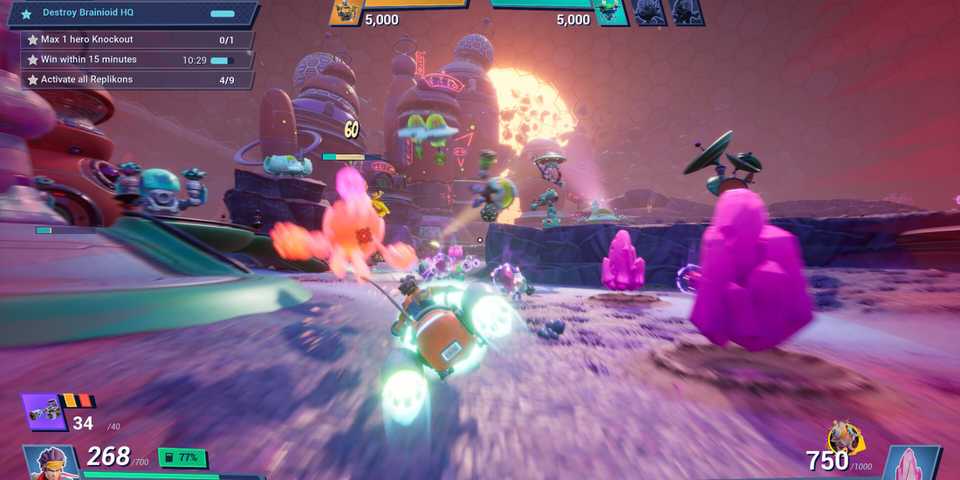
Chip 'n Clawz vs. The Brainioids is a new project headed up by the creator of X-COM, one that aims to bring together both RTS and third-person action elements. With hybrid gameplay and a comic book-inspired aesthetic, Chip 'n Clawz is offering players an interesting spread.
From the creator of X-COM, Chip 'n Clawz is an upcoming third-person action title that blends in RTS elements. The game follows the protagonist Chip, a young inventor who must save the world from the alien Brainioids with the help of his robo-cat, Clawz, and an army of minions. The Best War Games sat down with game director (and X-COM creator) Julian Gollop, art director Rossen Tzvetanov, alongside game designers Dean Calver and Nikola Petrov, all of whom spoke more about the game's development and how its characters were realized. This interview has been edited for brevity and clarity.

Hyper Light Breaker Dev Details Relationship with Arc Games
Hyper Light Breaker developer Heart Machine discusses how its partnership with Arc Games is helping deliver the best version of the game.
The Team Behind Chip 'n Clawz Talk Balancing Genres And Designing Characters

Q: Speaking generally, what's the process like for bringing a character from concept to final design? How many iterations of a character's design do you typically go through, and what factors do you consider when it comes to moving in the direction of one iteration over others?
Tzvetanov: The minions have a very big role in the game. It was very important to us for each minion to be easily recognized by players. The biggest factor was readability on the battlefield. For example, when you see a big gun that a ranged bot is going to shoot you with. The artillery is a huge rocket with legs that does tons of damage to buildings. Designing the minions and the buildings that spawn them was driven by these simple rules.
Gollop: There are usually 3 or 4 iterations at the concept art phase of the design before we commit to 3D modeling. When we had all the minion types and their buildings built in 3D, we made some further revisions to make certain buildings more distinguishable.
Calver: The hybrid RTS/third-person was the initial game concept; we wanted to bring something new to RTS, and while there have been a few previous games like this, it isn't a game design that's been explored that much. We specifically wanted the third-person camera to affect your strategy—you cannot see the whole map, you have to lead your minions and be close to them most of the time.
Q: Outside the main duo, which character went through the most changes?
Tzvetanov: I would say it was the final boss. He went through a lot of different iterations. At one point, he was a giant tentacle monster that was controlled by a brain. He proclaimed himself an emperor and had a crown that was shooting lasers. We also iterated a lot on the minions. As mentioned above, we wanted them to be very recognizable on the battlefield. We play-tested the game constantly to make sure they feel right.

Q: How well will players get to know the two main characters? How much story content will Chip 'n Clawz have?
Petrov: The story campaign features two types of levels—Story and Challenge missions. During each of them, the two heroes visit new places, meet new enemies, and get to know each other better, progressing the story. We've got numerous Brainioid characters, each with their own quirks, who contribute to the game's storytelling, usually by taunting our heroes.
During our design process, we made sure each level feels good and plays fun. Immediately after that, we made sure they'd feature unique places, dialogue, and collectibles that advance the story. This way, some players can have a great experience completing the objectives and advancing the plot at a lightning-fast pace, while other completionist-minded people can immerse themselves in our world, explore its backstory through secrets and collectibles, and pick up on clues of what's to come later in the story.
Gollop: You will certainly get to know Chip and Clawz quite well, often revealed by their banter. As Nikola says, there is a whole host of Brainioid characters, with increasing levels of incompetence and arrogance as you go through the story.
Q: In the concept art for the character of Clawz, there's a point where their dog-based design pivots to being cat-based. What caused this direction shift?
Tzvetanov: The dog was a leftover from a previous iteration of the game, and we felt we needed a change.
Gollop: In the dev team, the cat people won over the dog people.

Hyper Light Breaker Shows off Upcoming Character Rondo in New Trailer [EXCLUSIVE]
In an exclusive trailer provided to The Best War Games, Heart Machine debuts its upcoming Breaker, Rondo, for Hyper Light Breaker's next major update.
Balancing Chip 'n Clawz' Genres

Q: What motivated the decision to make the game a hybrid of third-person action and real-time strategy, rather than just one or the other?
Petrov: Ever since the beginning, we have had a vision for a pure hybrid game of equal parts action and strategy. This comes from a multitude of factors. First, we felt there hadn't been a lot of movement in the RTS scene, pretty much since StarCraft II. Some games have come and gone, but the genre has definitely taken a step back, and the players have moved towards MOBA games.
We wanted to create our own, modernized version of RTS gameplay. One that doesn't require the high APMs and intense eSports-style gameplay classic RTS is known for. On the other hand, we wanted to create a fun and engaging action game that isn't purely focused on the player hero, but involves strategic command of a small army of minions. The combination of the two immediately felt like a great fit.
Second, we've been inspired by games we love that we felt never got the appreciation they deserved. Titles like Brutal Legend, Pikmin, Overlord, Tooth and Tail, and Orcs Must Die! Were great inspirations and awesome examples of a fun mix of action and strategy. We wanted to contribute to this family of games with our own vision.
Gollop: We had a desire to do something different, initially as an experiment, which Dean and I prototyped in early 2020. It was a fun 1v1 multiple game with really quick and dynamic battles, lasting an average of 6 minutes. We came back to our prototype a year later and started figuring out how to make it into a full game with both single-player and multiplayer options.
Q: On a similar note, how have these two genres been balanced to stop them stepping on each other's toes?
Petrov: We've been wrestling with this question every step of the way since day one. Every little design decision had to take this into consideration: is this 'too strategy' for an action player, and is it 'too action' for a strategy player? We want armies, but do we want micro? We want melee combos, but what if a strategy player doesn't enjoy lightning-fast button mashing?
Our goal has always been to get the balance just right. We wanted to include the core fundamentals that make each genre fun—base building, army command, but also secret areas, collectibles, and fun combat. However, we were always careful not to lean too heavily on a specific aspect, so it became 'just an action game with some RTS' and vice versa.
It took a lot of iteration and some heated debates inside the studio, and we tested each feature as soon as we could. When we asked different players to play our alpha and beta, we were always looking for specific feedback: 'Did this Fortnite player grasp minion command?', 'Did this Warcraft player enjoy the shooting mechanics?', etc. When we got the thumbs up from our diverse playtesters, we knew the balance was right.
Gollop: The key to making it work was to keep the control scheme simple and constrained, avoiding the micromanagement traditionally associated with RTS games. The player has only four rally beacons, one for each minion type, to place on the map to direct troops. The Command View gives a great overview of the whole battle and can be quickly accessed at any time.
We had to balance the objectives and mechanics such that players are rewarded by using both the strategic controls and fighting directly in battles. Players may adopt a more action-based style or a more strategic style, which are both valid, and supported by various “HQ Mods” which offer buffs for character combat, minions, production and economy.

Q: Can you talk about some of the specific inspirations behind the game's designs, both of its main duo as well as the allied and Brainioids factions?
Petrov: It was an iterative process. For Clawz, we wanted her to look awesome and quirky, but also emphasize her robotic features—two things seemingly at odds. She looked great from the very beginning, right on the concept art sheet, and then the animators managed to put grace and playfulness in her movements. One seemingly small detail that had a great impact was making her ears rotate around just like a real cat's.
As for Chip, we initially had him look way more modern and trendy—he had rocked a sporty vest, frizzy hair, and showoff sneakers. However, we couldn't help but think that the vibe was somewhat wrong for his personality. After some experimentation, we took inspiration from our own world. We see the ruins of an ancient civilization all over the early parts of the game, as well as the collectible comic books. We asked ourselves—what if a descendant of these ancient people is now a modern-day boy interested in robotics? And that was the 'Eureka' moment. Our concept artists gave him cool tattoos that match the ancient ruins, wavy hair, and wavy scarf gave his movements a sense of flow, and his jumper and engineering accessories grounded him, making him feel like a modern-day kit-basher.
The Brainioids were a really fun challenge—ever since the beginning, we were committed to the brain-in-jar look, so we were somewhat limited in their visual design. They all look alike, and they don't wear clothes, so we had to get creative with their details. Their personalities vary greatly—for example, General Manager Blobbius is a maniac who yells orders, while Minda Thoughtsson is a collected and ice-cold corporate manager. We put a lot of emphasis on their speech, accents, quirks, and in terms of visuals, we gave them little accessories like glasses and hats. Our voice actors had an amazing time voicing their respective brains-in-jars and emphasizing their mannerisms.
Gollop: The brain-in-a-jar thing was somewhat inspired by a book I had read with my children called “My Arch-Enemy Is a Brain In a Jar” by David Solomon. Mars Attacks is also an inspiration, both for the humor and satire in Chip ‘n Clawz.

Q: What inspired the comic book aesthetics in Chip 'n Clawz' aesthetic?
Tzvetanov: That's a funny one. I wanted to create a Christmas card to wish happy holidays to the colleagues in the studio. I was inspired by the looks of vintage comic books and I started exploring some ideas. The card featured the final boss monster invading our holidays. Later on, we refined the idea, and we started pushing the comic book aesthetics in the game.
Q: Regarding the game's comic book collectibles, how important will collectibles be to the experience? What rewards can players expect for collecting items such as these?
Petrov: We've got multiple types of collectibles. Some are upgrades that allow the players to unlock new weapons and upgrades, and directly help them progress the campaign by allowing them to use new strategies. Others, like our collectible cards, detail pieces of the world and gameplay mechanics. While the game has a detailed tutorial, amassing a big collection of cards allows players to reference different mechanics and strategy tips right there in the gallery. We thought it was cool to put inside the game some of the things players would usually go look up on the internet.
Our comic book collectibles feature story bits that are not part of the main campaign. They have a chronological order, but are scattered all throughout the campaign. Collecting them all creates a timeline that provides an interesting backstory to our world and explains some of the events mentioned in the dialogue. While they are not at all required to grasp the game's story, reading through the 'back covers' of the comic books expands the player's understanding of the game universe.

Q: Was Chip 'n Clawz always envisioned as a game centering on a duo of protagonists, or was it at any point imagined as a solo adventure?
Petrov: Quite the opposite, the game was initially envisioned as a multiplayer-only battle. Early in development, we decided to also develop a story campaign, and this, in turn, quickly evolved into a co-op design. Solo playability was always a high priority, and we made sure the entire game can be played solo, and inviting a buddy creates different opportunities, strategies, and fun gameplay, but is never required. Each story mission can be completed solo or in co-op, allowing our players nice flexibility.
Calver: The very earliest version wasn't a duo; it was just a PvP test of some of the basic game design elements, and the visual or narrative design wasn't thought about at all. After that, we decided that co-op would be a great way to play, and so a duo became a natural idea.
[END]




- ESRB
- T For Teen // Violence
- Developer(s)
- Snapshot Games
- Publisher(s)
- Arc Games
- Multiplayer
- Local Co-Op, Local Multiplayer, Online Co-Op, Online Multiplayer