


Summary
- Some open-world games prioritize player exploration over clear objectives and guidance.
- Games like Sable, Death Stranding, and Elden Ring embrace being lost as part of the experience.
- Disorientation in games like No Man's Sky, Subnautica, and Breath of the Wild adds to the immersive journey.
There are open-world games that give players a neatly labeled map, waypoints, and a glowing golden path to follow. And then there are games that drop them into the unknown, offer a vague nudge in some direction, and let them spiral into the kind of delightful disorientation that turns wandering into wonder. This list is about the latter—the games where feeling lost isn’t a flaw, it’s a feature.

7 Best Open World Games With No Enemies, Ranked
If you want to get the open-world experience, but don't want to fight off hordes of enemies, these games are perfect.
These are the titles that make players check the map five times and still wonder where the map even is. Not because they’re badly designed, but because getting lost is part of the magic.
7 Sable
It Doesn’t Tell You Where To Go—And That’s Exactly Why You Go

Sable

- Released
- September 23, 2021

WHERE TO PLAY

- ESRB
- e
- Developer(s)
- Shedworks
- Genre(s)
- Adventure
- Platform(s)
- PC, PS5, PS4, Xbox One, Xbox Series X, Xbox Series S

There’s no combat, no death, no failure state. Just a masked girl named Sable on a coming-of-age journey through a pastel desert that looks like it was painted with the daydreams of Moebius. It’s easy to feel lost in Sable, and that’s entirely the point. There’s no mini-map telling players where to go, no compass with flashing icons. Just a hoverbike and a world scattered with ancient ruins, shipwrecks, and strange strangers who never seem in a rush.
What makes Sable special is how it embraces the feeling of being lost without ever making it frustrating. The game trusts players to chase what catches their eye, to piece together the lore from environmental clues, and to find their own path—both physically and emotionally. Every landmark feels like a whisper from the past, every journey feels like a self-chosen pilgrimage. It’s not about finding the fastest route, it’s about not minding when there isn’t one.
6 Death Stranding
Kojima’s Strangest Delivery Route Is Also Its Most Profound

Death Stranding
- Released
- November 8, 2019



WHERE TO PLAY







- ESRB
- M for Mature: Blood, Intense Violence, Partial Nudity, Strong Language
- Developer(s)
- Kojima Productions
- Genre(s)
- Action
- Platform(s)
- iOS, PC, PlayStation 4, PlayStation 5, Xbox Series X, Xbox Series S
Getting lost in Death Stranding isn’t just spatial—it’s existential. Players are Sam Porter Bridges, hauling packages across a rain-soaked, post-apocalyptic America where the topography feels like it’s trying to kill them and the sky rains time. GPS exists, technically, but players still find themselves charting the terrain by foot, one slippery slope at a time, often wondering whether that shortcut was worth the broken cargo and twisted ankle.
There’s a deep loneliness embedded in every trek. Sometimes hours pass without another soul, only the haunting wails of BTs or the crackle of a tired radio to keep company. But it’s all by design. Kojima created a world where disconnection is the enemy, and reconnecting the broken pieces of humanity is the point. Getting lost is what Death Stranding wants players to feel, until they build the roads, zip-lines, and bridges that make future journeys a little less isolating—for them, and for others.
5 Elden Ring
A Foggy Map, A Cryptic World, And A Thousand Ways To Die Wondering

Elden Ring
- Released
- February 25, 2022


WHERE TO PLAY


- ESRB
- M for Mature: Blood and Gore, Language, Suggestive Themes, Violence
- Developer(s)
- From Software
- Platform(s)
- PC, PlayStation 4, PlayStation 5, Xbox One, Xbox Series S, Xbox Series X
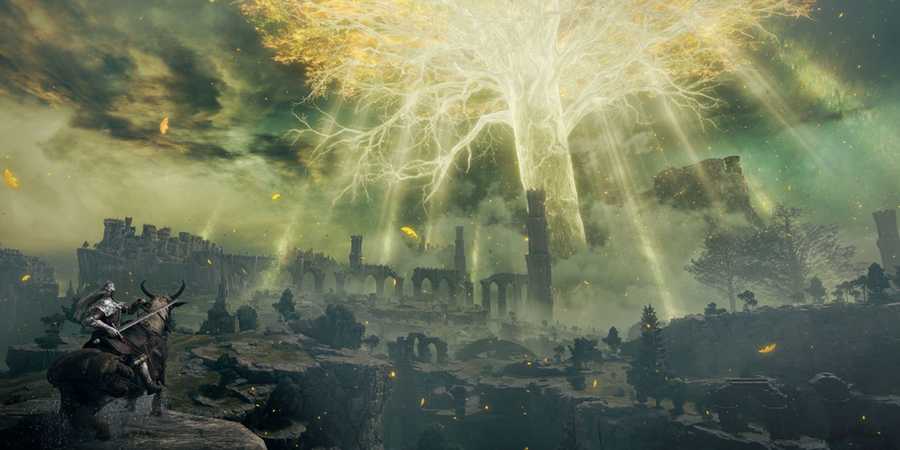
No one really knows what they’re doing in Elden Ring, at least not at first. Even the tutorial is easy to miss. But that sense of disorientation is where the magic lies. The Lands Between is vast and terrifying, but also weirdly inviting. Players leave the safety of the starting area, see the Tree Sentinel casually patrolling on horseback, and immediately get flattened. That’s Elden Ring's version of saying “Welcome.”

7 Best Open World Games That Must Be Completed Within a Time Limit, Ranked
Players having to overcome the final part of a game can be thrilling. Its even more thrilling when you need to beat the whole game in a time limit.
What makes the open world so uniquely disorienting isn’t just its size, but its refusal to explain itself. NPCs speak in riddles, questlines have no logs, and half the caves don’t even appear on the map until players trip into them. But somehow, it all clicks. Players start to recognize patterns, notice that a suspicious-looking tree might actually be a hidden boss, and learn that sometimes the best direction to head is the one that looks the least inviting. And that cryptic layering? It’s FromSoftware’s way of making the world feel truly ancient, like something players are uncovering, not just playing through.
4 No Man’s Sky
In Space, No One Can Hear You Ask “Where Am I?”

No Man's Sky
- Released
- August 9, 2016
WHERE TO PLAY


- ESRB
- T for Teen: Fantasy Violence, Animated Blood
- Developer(s)
- Hello Games
- Platform(s)
- PlayStation 5, PlayStation 4, Xbox Series X, Xbox Series S, Xbox One, Nintendo Switch, PC, Nintendo Switch 2

Imagine waking up on a random planet with no memory, no instructions, and a slowly draining life support meter. That’s how No Man’s Sky begins, and even after dozens of hours, the feeling of being lost never really leaves. Which is, frankly, part of its charm. Players bounce from one procedurally generated planet to another, scanning flora, mining elements, and gradually learning a new alien language syllable by syllable.

10 Best Open-World Games That Aren't RPGs, Ranked
Not all open-world games are RPGs. These titles prove exploration, creativity, and action can shine without leveling systems or stats.
But it’s the sheer scale of it all that makes the disorientation feel real. There are over 18 quintillion planets, each with its own bizarre ecosystems and weather patterns. The world isn’t just big—it’s unknowable. And since the game doesn’t nudge players toward a single goal, it’s easy to wander off on a tangent and spend hours cataloging fungal trees or trying to tame a six-legged, giraffe-lizard hybrid with a squeaky voice. Even with all the updates that added more structure, No Man’s Sky is still at its best when players stop trying to get somewhere and just float.
3 Subnautica
A Dive Into Alien Waters That Feel Just Familiar Enough To Drown In

Subnautica
- Released
- January 23, 2018
WHERE TO PLAY

- ESRB
- E10+ for Everyone 10+: Fantasy Violence, Mild Language
- Developer(s)
- Unknown Worlds Entertainment
- Platform(s)
- Nintendo Switch, PC, PlayStation 4, PlayStation 5, Xbox One, Xbox Series X, Xbox Series S
The moment the escape pod door opens and the endless ocean stretches in every direction, it becomes clear—Subnautica doesn’t care if players are ready. There's no compass at first, no clear objective beyond "don’t die," and the deeper players go, the less they understand. What starts as a desperate scramble to find food and water soon spirals into a chilling mystery about a lost alien civilization, an ancient disease, and the creatures that definitely noticed the crash landing.
The feeling of being lost is literal—depths become darker, directions become meaningless, and familiar landmarks disappear behind curtains of silt and reef. Every biome has its own personality, from the safe shallows to the eerie blood kelp zones, and the game never holds the player's hand as they drift further from safety. That fear of not knowing what’s around the next corner? It never really goes away, especially when the sound design ensures every distant rumble could be something massive swimming just out of sight.
2 The Legend of Zelda: Breath of the Wild
The Wind Knows The Way—But It Won’t Tell You Twice

The Legend of Zelda: Breath of the Wild
- Released
- March 3, 2017

WHERE TO PLAY
- ESRB
- E for Everyone: Fantasy Violence, Use of Alcohol, Mild Suggestive Themes
- Developer(s)
- Nintendo EPD
- Platform(s)
- Nintendo Wii U, Switch
There’s a moment in Breath of the Wild where players finally descend from the Great Plateau, take their first steps into Hyrule proper, and realize they have absolutely no idea what to do next. That moment? It’s everything. Nintendo tore up the traditional Zelda rulebook with this one—no forced dungeons, no item gating, just a broken world, a vague goal to defeat Calamity Ganon, and the freedom to get distracted by a thousand tiny things along the way.
Every hill hides a Korok seed, every ruin tells a silent story, and even the weather feels like it’s conspiring to change plans. There are no glowing markers forcing progression, just the player's own curiosity dragging them in directions they didn’t intend to go. What makes the feeling of being lost so potent is that Hyrule is so meticulously crafted, it feels like every inch was placed for a reason—even if that reason is just to make players pause and wonder what happened there.
1 Outer Wilds
You’re Not Just Lost In Space—You’re Lost In Time

Outer Wilds
- Released
- May 28, 2019
WHERE TO PLAY
No other game weaponizes the concept of being lost quite like Outer Wilds. Players take on the role of a rookie astronaut from a species that built spaceships out of wood and curiosity, and they have just 22 minutes before the sun explodes and the cycle resets. There’s no leveling up, no combat, and no upgrades. The only progress is knowledge—hard-earned and entirely self-directed.
Everything in Outer Wilds is a breadcrumb trail waiting to be followed, and it’s possible to finish the entire game without visiting half the planets if players manage to untangle the right threads.
But that’s the beauty of it. Getting lost isn’t just likely, it’s inevitable—and encouraged. Black Hole Forge, The Ash Twin Project, quantum objects that move when unobserved... Every discovery feels like stepping deeper into a cosmic puzzle box with no clear instructions. The feeling of helpless awe that comes from watching a planet disintegrate before landing on it? That’s not just part of the game. That is the game.

The Biggest Open World Games Based On The Size Of Their Maps
When it comes to open world games, more map means more places to explore, and these are the 10 games with the biggest maps of all.