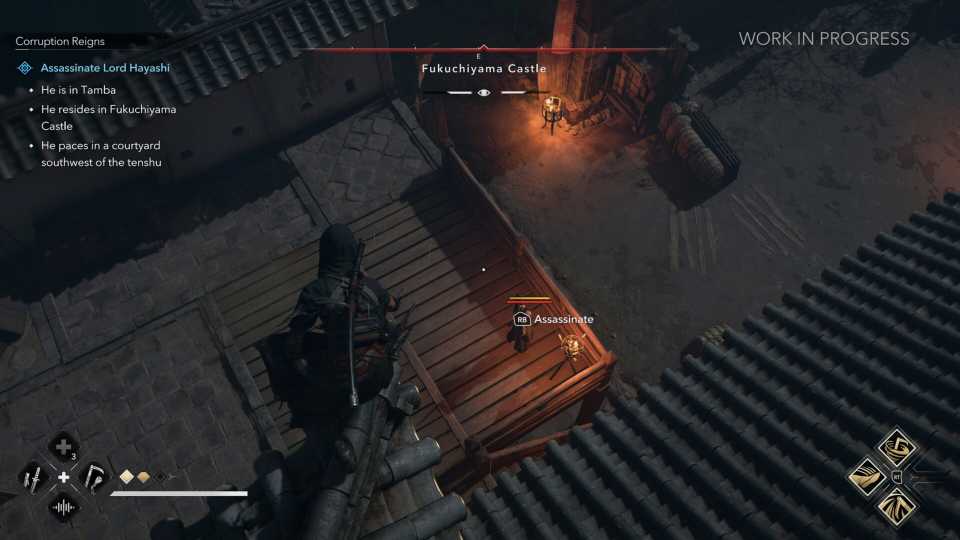
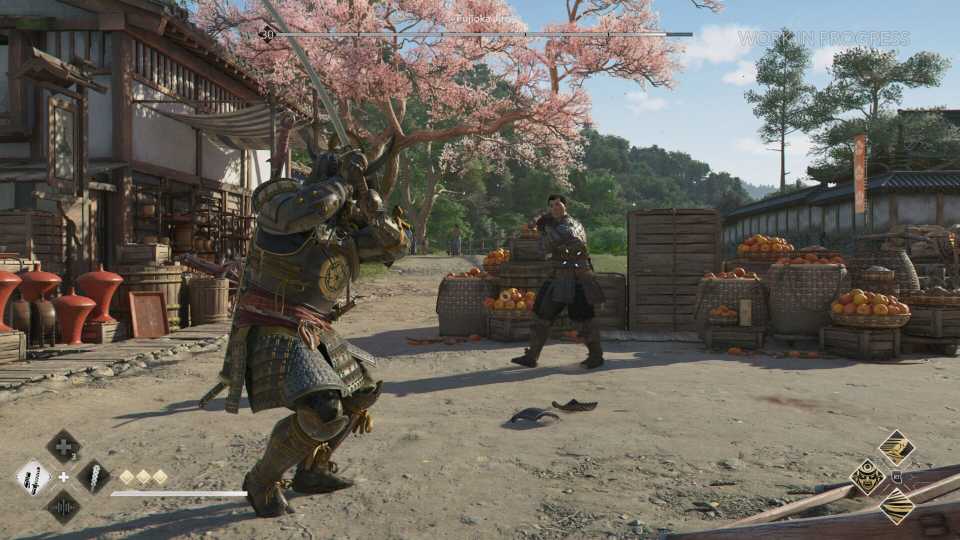
Parkour mechanics bring a unique feeling to a game, and one of the franchises best associated with the thrill of jumping from rooftop to rooftop is easily Assassin’s Creed. That proud tradition carries on in Assassin’s Creed Shadows. In Shadows, Sengoku-era Japan becomes the backdrop for that freerunning feeling.
The Best War Games recently spoke to associate game director Simon Lemay-Comtois and graphics architecture team lead Dominic Gladu-Despatis about how parkour factors into Assassin’s Creed Shadows. In turn, we also spoke about how feudal Japan factors into that parkour.

Assassin's Creed Shadows Details Its Stealth Gameplay
Assassin's Creed Shadows features an overhauled stealth system that sees dual protagonists Yasuke and Naoe handled very differently.
A Uniquely Japanese Kind of Parkour
Each Assassin’s Creed Shadows protagonist brings unique perspectives on their abilities when it comes to freerunning. Yasuke doesn’t have the same kind of speed or agility as Naoe, but when Naoe takes her leaps from the rooftops, Yasuke explores the world from the ground. This perspective is important because Naoe more easily takes in the big picture, while Yasuke lets players stop and smell the roses of the more human surroundings.
Gladu-Despatis explained that, in both cases, the driving factor behind parkour's depiction in AC Shadows is the architectural styles of Sengoku Japan. The architecture of the era is fairly unique, with stronger slopes and more verticality than most AC settings. As always, the time and place of the game’s setting is one of the most important things to communicate, with Gladu-Despatis saying,
"The architecture research for AC Shadows contributed to the way a player parkours on several levels. With regards to the player's orientation towards his objectives: as you come across huge temples and castles, looking up at it all, it gives a direction and a captivating objective for the player each time they play or enter a new area. The same goes for the uniqueness of the architecture seen as you perform rooftop stealth gameplay–it gives players unique ways to reach their objectives more discreetly."
Naoe’s style of parkour is very much influenced by the architecture. She has a grappling hook, for example, that helps her grab on to overhangs that would pose a significant challenge to standard freerunning techniques. Her unique tools and agile approach let her cover more ground in less time than others. Yasuke is literally more grounded; his approach to parkour is more street-level, having to use more ordinary tools to get where he needs to go, like staircases or ladders. Instead of leveraging the architecture as Naoe does, his perspective shows it off in its splendor.
That architecture posed a challenge for Gladu-Despatis. He said it was important to capture the complexity and make the result authentic and credible in its historicity. Compared to previous Assassin's Creed games, Sengoku Japan’s architecture was more complicated than in previous installments.
Elevating Assassin’s Creed Shadows’ Parkour
Architecture was front-and-center in the considerations on the Assassin’s Creed Shadows approach to parkour, but it wasn’t the only consideration. Developers also looked to the series’ past, and the ‘up’ and ‘down’ of parkour for things that could refine the series’ major navigation mechanic. Lemay-Comtois explained how that evolution of the system took shape in the most recent title:
"Like many things on Shadows, it’s a blend of “old-school” implementations–mandatory handgrips, hard jump metrics, important distinctions between Parkour Up & Parkour Down–while incorporating a few “new-school” features such as stance-switching (which now includes a prone stance), automated Passovers, and deep levels of destruction on most elements you can bump into, which has some relevance as to what Yasuke can climb onto or explode under his weight."
Movement mechanics are inexorably linked to both stealth and parkour mechanics, and parkour and stealth are inexorably linked to one another. Movement is a building block for the more complicated systems that are critical to what Assassin’s Creed is as a franchise.
Developers went on site in Japan, seeing some of the many castles of the Sengoku era that dot the landscape in AC Shadows, to understand the scale inside and outside of castles. These areas are not only important for combat, but players are going to want to climb them. The overhanging roofs are just one reason why the grappling hook became a necessity. Meanwhile, the team studied the manner of construction, the materials used, the way the castles were designed to pose danger to anyone–like assassins–seeking to breach them, and the parkour they’d need to implement.
Taken all together with the refined parkour of previous titles and the attention to the architectural detail, as well as two different ways to engage with parkour in Assassin’s Creed Shadows, it’s poised to present a fascinating, high-energy experience for players.


Assassin's Creed Shadows



-
 OpenCritic Reviews
- Top Critic Avg: 81 /100 Critics Rec: 82%
- Released
- March 20, 2025
- ESRB
- Mature 17+ // Blood and Gore, Intense Violence, Language
- Developer(s)
- Ubisoft Quebec
- Publisher(s)
- Ubisoft